

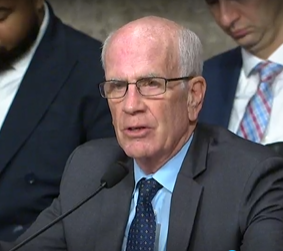
Earlier this week, the Senate Judiciary Committee held confirmation hearings for various nominees including Andrew Duva to be Assistant Attorney General of the DOJ’s Criminal Division.
During the hearing (at approximately 1:45), Senator Peter Welch (D-VT) stated: “I am very concerned, to be candid, that the Trump administration seems to be taking the position that we shouldn’t enforce [the Foreign Corrupt Practices Act].”
Senator Welch then referenced the August FCPA enforcement action against Liberty Mutual saying that the DOJ “declined to prosecute” the company and he asked Duva about his position on “VIGOROUS” enforcement of the FCPA (word emphasized).
The sequencing of Welch’s question seemed to infer that the Liberty Mutual enforcement action was not “vigorous” and he – perhaps conveniently – failed to mention that Liberty Mutual agreed to pay $4.7 million to settle the matter even though it is difficult to glean from the DOJ’s “declination with disgorgement” letter just what viable FCPA anti-bribery violations Liberty Mutual committed.
Perhaps Senator Welch was also unaware (or chose to ignore) other FCPA enforcement activity since August including a completed FCPA trial and several trials scheduled to begin in the near future.
Senator Welch’s question more broadly raises the issue of what does “vigorous” FCPA enforcement actually mean?
Staying with “declinations with disgorgement,” the Liberty Mutual action was the 20th FCPA matter resolved this way since 2016 when the DOJ in the Obama administration introduced this alternative resolution vehicle to FCPA enforcement. The settlement amounts in several FCPA “declinations with disgorgement” have exceeded $10 million.
Do FCPA “declinations with disgorgement” represent “vigorous” FCPA enforcement?
In 2004, the DOJ in the Bush administration used a non-prosecution agreement for the first time in an FCPA matter. This alternative resolution vehicle has been used numerous time since by the DOJ in all subsequent Presidential administrations.
Do FCPA NPA’s represent “vigorous” FCPA enforcement?
In 2005, the DOJ in the Bush administration used a deferred prosecution agreement for the first time in an FCPA matter. This alternative resolution vehicle has been used numerous time since by the DOJ in all subsequent Presidential administrations.
Do FCPA DPA’s represent “vigorous” FCPA enforcement?
In April 2016, the DOJ in the Obama administration issued an FCPA “pilot program.” As stated in the DOJ press release:
“By contrast, when a company not only cooperates and remediates, but also voluntarily self-discloses misconduct, it is eligible for the full range of potential mitigation credit. That means that if a criminal resolution is warranted, the Fraud Section may grant a reduction of up to 50 percent below the low end of the applicable U.S. Sentencing Guidelines fine range, and generally will not require appointment of a monitor. In addition, where those same conditions are met, the Fraud Section’s FCPA Unit will consider a declination of prosecution.”
DOJ policy on FCPA enforcement addressing the same issues and concepts has since been carried forward with various revisions by the DOJ in all subsequent Presidential administrations.
Does long-standing DOJ policy offering business organizations various penalty reductions represent “vigorous” FCPA enforcement?
The same general question could also be asked about other aspects of “modern” (since 2004) FCPA enforcement by the DOJ in all Presidential administrations.
What does “vigorous” FCPA enforcement mean?
Does it mean the number of enforcement actions brought each year (regardless of enforcement theory or resolution vehicle used)?
How vigorous should “vigorous” FCPA enforcement be given that several FCPA enforcement actions by the DOJ across various Presidential administrations have involved instances of prosecutorial misconduct or other mishaps. (See here, here, and here).
