A few hours after the DOJ announced a March 28th Foreign Corrupt Practices Act action against Trafigura (see here and here for prior posts) the DOJ also announced (what was increasingly becoming obvious over the last few years) that “its long-running investigation into international commodities trading companies that paid bribes to win business with state-owned and state-controlled oil companies in Latin America and Africa has resulted in six corporate resolutions, 20 convictions of individuals, and total fines, forfeitures, and other penalties of more than $1.7 billion.”
As stated in the DOJ release:
“[T]he Criminal Division’s Fraud Section’s Foreign Corrupt Practices Act (FCPA) Unit, in partnership with U.S. Attorneys’ Offices across the country, the Money Laundering and Asset Recovery Section, and the FBI, has been investigating corruption committed by international commodities trading companies, which paid millions of dollars in bribes to corrupt government officials to secure billions of dollars in business with state-owned enterprises.”
This post unravels the many enforcement actions and explores its origin and common actors.
The first fruits of the overall investigation appears to be the February 2019 criminal charges (and related plea agreement) involving Rodrigo Garcia Berkowitz.
As described in the February 2019 criminal information charging Berkowitz with conspiracy to commit laundering, Berkowitz (a Brazilian citizen) worked as a trader of fuel oil and related products for Petrobras (described as Brazil’s state-owned and state-controlled oil company). According to the DOJ, between 2010 and 2014, Berkowitz was located in Houston, Texas working for a wholly-owned subsidiary of Petrobras.
The information alleged that various intermediaries and other employees and agents of certain companies involved in the international trading of fuel oil and other commodities corruptly offered and paid bribes to foreign officials, including Berkowitz and others, in order to obtain and retain business with Petrobras.
The information referenced three trading companies:
- Trading Company 1 – described as a subsidiary of a Dutch international energy and commodities trading company incorporated in the U.S. with its principal place of business in Houston;
- Trading Company 2 – described as an international energy and commodities trading company incorporated in Singapore with its principal place of business in Switzerland; and
- Trading Company 3 – described as a oil trading company incorporated in the U.S. with its principal place of business in Connecticut.
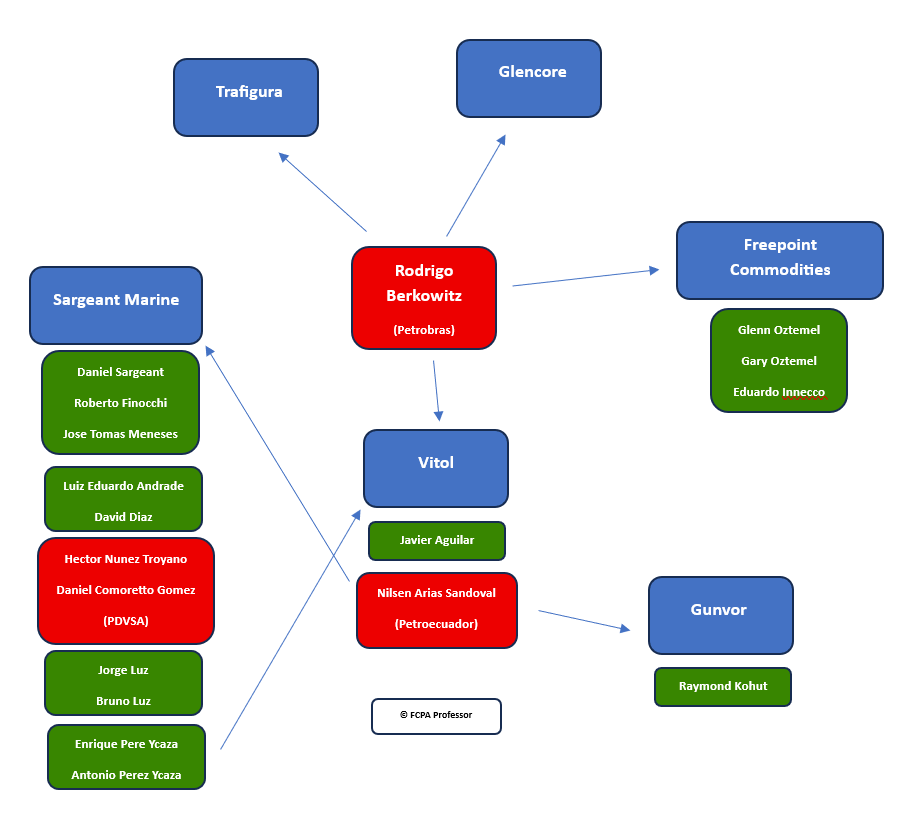
Trading Company 1 is a fairly obvious reference to Vitol, a company which resolved an FCPA enforcement action in late 2020 concerning bribery schemes in Brazil involving Petrobras as well as separate bribery schemes in Ecuador and Mexico (see here and here for prior posts). In connection with the Vitol Ecuador and Mexico bribery schemes, Javier Aguilar (a former Vitol employee) was also criminally charged and convicted (see here) and in connection with the Ecuador bribery scheme the DOJ also criminally charged Nilsen Arias Sandoval (a citizen of Ecuador and a former senior manager at Petroecuador – see here).
Trading Company 2 is a fairly obvious reference to Trafigura, a company which resolved an FCPA enforcement action last month concerning bribery schemes in Brazil involving Petrobras.
Trading Company 3 is a fairly obvious reference to Freepoint Commodities, a company which resolved an FCPA enforcement action in late 2023 concerning a Brazilian bribery scheme involving Petrobras. (See here for the prior post). In connection with the Freepoint enforcement action, brothers Glenn Oztemel and Gary Oztemel (former Freepoint traders) as well as Eduardo Innecco (an agent for Freepoint) were charged with FCPA and related offenses in connection with the bribery schemes. (See here and here).

Nilsen Arias Sandoval was a key figure to the overall investigation in that he was charged not only in connection with Vitol’s Ecuador bribery scheme, but also separate bribery schemes involving Gunvor and Sargeant Marine.
As highlighted in this prior post, in early March 2024 Gunvor (a Switzerland based commodities firm) resolved an FCPA enforcement action in connection with a Petroecuador bribery scheme. It was the same bribery scheme that Raymond Kohut (a Canadian citizen who lived in the Bahamas and worked in business development for Gunvor) pleaded guilty to in early 2021 (See here for the prior post).
As highlighted in this prior post, in September 2020, Sargeant Marine (a Florida based asphalt company) resolved an FCPA enforcement action concerning bribery schemes in Ecuador, Brazil, and Venezuela. In connection with the various Sargeant Marine bribery schemes the DOJ also criminally charged:
- Daniel Sargeant (a company executive) and Roberto Finocchi and Jose Tomas Meneses (Sargeant Marine traders);
- Luiz Eduardo Andrade and David Diaz (an agent and consultant for Sargeant Marine who acted as bribe intermediaries in Brazil and Ecuador);
- Hector Nunez Troyano (a manager at Venezuela’s PDVSA involved in the sale of asphalt) and Daniel Comoretto Gomez (a manager of PDVSA involved in the trading of asphalt); and
- the father-son duo of Jorge Luz and Bruno Luz (who created offshore shell companies in the Marshall Islands that entered into fake consulting agreements with Sargeant Marine companies in connection with the Brazil bribery schemes).
Separately, the DOJ also criminally charged brothers Enrique Pere Ycaza and Antonio Pere Ycaza in connection with the Ecuador portions of the Sargeant Marine bribery schemes and Vitol bribery schemes. (See here for the prior post). As alleged by the DOJ, Enrique (a citizen of Ecuador and Spain) provided consulting services, incorporated consulting businesses, and opened bank accounts in the U.S. and elsewhere to facilitate the bribery schemes and Antonio (a citizen of Ecuador, Spain and U.S. who resided in Miami) exercised control over companies and bank accounts in the U.S. and elsewhere that were used to facilitate the payment of bribes. Interestingly, the Ycaza brothers also provided “consulting” services to Gunvor in connection with various Ecuador bribery schemes.
Thus far, Glencore (a commodities company incorporated in the United Kingdom and headquartered in Switzerland) has been left out of the analysis, but in May 2022 the company resolved an FCPA enforcement action concerning bribery schemes in Nigeria, Cameroon, Ivory Coast, Equatorial Guinea, Brazil, Venezuela, and the Democratic Republic of Congo.” (see here for the prior post). As to Brazil, the DOJ alleged:
“Glencore, through certain of its employees and agents, including Employee X (a Brazilian citizen involved in business development for Glencore Brazil), Employee Y (a Mexican citizen who was a senior employees at Glencore Mexico), Brazil Consultant (a Brazilian citizen and intermediary), and others, caused approximately $147,202 to be used, at least in part, as corrupt payments to be made to, and for the benefit of, Brazilian officials, in order to secure improper business advantages. Specifically, Employee X negotiated with Brazil Consultant to pay approximately $147,202 to Brazil Consultant, knowing that a portion of the funds would be paid in bribes to Petrobras officials, in exchange for Glencore having the opportunity to buy oil cargo from Petrobras.”
The description of Brazil Official 1 (a Brazilian citizen and an oil trader for Petrobras who, from 2010 and 2014 was based in Houston) fits the description of Berkowitz as highlighted above.
If all of the above is a bit too much to keep track of without a flow chart, I agree. Hopefully, the below flow chart helps connect the dots in the DOJ’s overall investigation.