


Last week, Wal-Mart made several disclosures that touched upon its Foreign Corrupt Practices Act scrutiny and compliance enhancements.
This post highlights FCPA and related information in Wal-Mart’s Annual Report, Proxy Statement, Global Ethics and Compliance Report, and Global Responsibility Report.
The Global Ethics and Compliance Report in particular will be of interest to compliance practitioners.
In short, regardless of what may (or may not) have happened at Wal-Mart approximately 5-10 years ago, it is clear that Wal-Mart has become an industry-leader in FCPA compliance best practices. Anyone who fails to acknowledge this is simply not credible.
Global Ethics and Compliance Report
Continuous Improvement in Anti-Corruption
Walmart’s anticorruption program was designed and implemented based on the advice and guidance of internal and external experts. This design includes a global anticorruption policy and market-specific anticorruption procedures that address a number of topics such as due diligence in engaging third parties, business expenditures, charitable contributions and sponsorships, licenses and permits, acquisition or lease of property from government entities, government inspections, recordkeeping, and reporting allegations, among others. We continued to build and refine the program in FY16. At the end of the year, we had a team of more than 100 dedicated anticorruption associates who live and work around the world, but who report centrally and are led by a dedicated global anticorruption officer. Together, these anticorruption associates conduct due diligence and an annual risk assessment, develop and provide anticorruption training and messaging, oversee the implementation of anticorruption policies and procedures, and monitor and evaluate our program.
In FY16, we expanded our program for regularly monitoring our company’s performance in implementing our anticorruption policies and procedures. The company now has a global continuous improvement team that constantly assesses and improves the implementation of the program in all of our retail markets. This monitoring provides feedback to the business on how they follow the company’s anticorruption controls so any issues are identified and addressed early. This monitoring does not replace the work of our Internal Audit team, which continues to perform its independent auditing function. Rather, we view this monitoring as an additional line of defense against anticorruption risk.
Managing Our Third Party Risk
Like many businesses, we sometimes need third parties to interact with the government on our behalf. These third-party intermediaries can help us with regular business activities such as responding to government requests for information, handling legal or regulatory proceedings, and real estate design and construction. These third parties provide needed expertise and make our processes more efficient, but because these individuals and companies interact with government officials around the world, they also impact our risk profile.
We seek to be both innovative and deliberate in managing this risk. We have created a thorough process to screen and conduct due diligence on potential third-party partners. As part of that process, we worked with external experts to create a customized electronic system that screens for third-party intermediaries in our business and conducts due diligence on individuals and companies who seek to represent us.
Additionally, when we contract with third-party intermediaries, we require them to adopt commitments to follow our anticorruption policies. We want to help our third-party partners understand and apply these anticorruption standards, so we’ve invested heavily in anticorruption training. As of the end of FY16, we have provided anticorruption training to over 1,300 third-party companies and groups. In addition to reducing our risk by providing this Walmart-developed training, we have also provided our third-party partners with the ability to share our anticorruption e-learning training with others throughout their organization.
This past year we also developed what we consider to be a leading practice in anticorruption compliance. In addition to the screening, due diligence, contractual commitments, and training that we utilize, we partnered with external experts to develop a methodology for proactively auditing a sample of our third-party partners in our higher-risk markets. These audits are not triggered in response to a concern or allegation about the third party. Rather, under our new protocol, we selected a sample of companies for an audit based on several factors, including the risks associated with the region where the third party operates and the type of service that it provides. Through this process, we were able to examine the way that the third parties responded to our anticorruption program and identified areas where we can continue to improve our training and controls. Because of the insight these proactive audits provided, in fiscal year 2017 (“FY17”) we intend to expand this program to all of our retail markets.
Global Donation Management
Walmart’s Global Donation Management System (“GDMS”) is another example of recent enhancements to our ethics and compliance systems. GDMS is a web-based application we created to manage donations to governments, charities, and other non-governmental organizations. GDMS has two components: a website to manage due diligence, registration, and approval of potential donation recipients; and a store solution to manage approval and accounting for product donations that are made at the store level. Through the website, potential donation recipients can register their organization and submit a funding request, which is then routed automatically to our anticorruption due diligence tool discussed above, and from there to our internal approval process. At the store level, associates can use GDMS to scan products to be donated to a recipient and the tool will automatically validate that the potential recipient has been approved through our processes, while also validating that the product to be donated is appropriate (for instance, donations of tobacco products are automatically restricted but food, water, and clothing are permitted). Walmart has a long history of supporting the needs of our communities. In 2014 alone, Walmart and the Walmart Foundation gave $1.4 billion in monetary and in-kind contributions around the world. Global in-kind donations accounted for approximately $1 billion of that amount, while monetary donations of approximately $309 million were given globally. Additional information on these efforts can be found here. GDMS facilitates such contributions while also reducing our risk by making the process for reviewing potential donations more efficient. Walmart implemented GDMS in several of our international markets in FY16. We plan to expand the system to additional markets in the coming year.
Walmart continues to enhance its processes and systems to help prevent corruption – that is, the use of improper payments or anything of value, including gifts or travel, to secure an improper business advantage from a government official or commercial party. In 2015 and early 2016, we published updated, unified anti-corruption compliance procedures to promote consistency across all Walmart markets. We continued to implement our Global Donations Management System (GDMS) to automate and simplify our donations processes. We established a program to audit a sample of our third-party intermediaries in high-risk markets. We expanded our anti-corruption continuous improvement program to monitor progress and identify enhancement opportunities. Furthermore, we continued to provide risk-based training to our associates and third-party intermediaries. In 2015 alone, we delivered anti-corruption training to more than 100,00 Walmart associates at all levels, and provided live, instructor led training to more than 18,000 associates. To date, we have provided anti-corruption training to more than 1,300 external entities that interact on our behalf.
FCPA Investigation and Related Matters
The Audit Committee (the “Audit Committee”) of the Board of Directors of the Company, which is composed solely of independent directors, is conducting an internal investigation into, among other things, alleged violations of the U.S. Foreign Corrupt Practices Act (“FCPA”) and other alleged crimes or misconduct in connection with foreign subsidiaries, including Wal-Mart de México, S.A.B. de C.V. (“Walmex”), and whether prior allegations of such violations and/or misconduct were appropriately handled by the Company. The Audit Committee and the Company have engaged outside counsel from a number of law firms and other advisors who are assisting in the on-going investigation of these matters.
The Company is also conducting a voluntary global review of its policies, practices and internal controls for anti-corruption compliance. The Company is engaged in strengthening its global anti-corruption compliance program through appropriate remedial anti-corruption measures. In November 2011, the Company voluntarily disclosed that investigative activity to the U.S. Department of Justice (the “DOJ”) and the Securities and Exchange Commission (the “SEC”). Since the implementation of the global review and the enhanced anti-corruption compliance program, the Audit Committee and the Company have identified or been made aware of additional allegations regarding potential violations of the FCPA. When such allegations are reported or identified, the Audit Committee and the Company, together with their third party advisors, conduct inquiries and when warranted based on those inquiries, open investigations. Inquiries or investigations regarding allegations of potential FCPA violations have been commenced in a number of foreign markets where the Company operates, including, but not limited to, Brazil, China and India.
The Company has been informed by the DOJ and the SEC that it is also the subject of their respective investigations into possible violations of the FCPA. The Company is cooperating with the investigations by the DOJ and the SEC. A number of federal and local government agencies in Mexico have also initiated investigations of these matters. Walmex is cooperating with the Mexican governmental agencies conducting these investigations. Furthermore, lawsuits relating to the matters under investigation have been filed by several of the Company’s shareholders against it, certain of its current directors, certain of its former directors, certain of its current and former officers and certain of Walmex’s current and former officers.
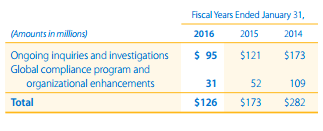
The Company could be exposed to a variety of negative consequences as a result of the matters noted above. There could be one or more enforcement actions in respect of the matters that are the subject of some or all of the on-going government investigations, and such actions, if brought, may result in judgments, settlements, fines, penalties, injunctions, cease and desist orders, debarment or other relief, criminal convictions and/or penalties. The shareholder lawsuits may result in judgments against the Company and its current and former directors and officers named in those proceedings. The Company cannot predict at this time the outcome or impact of the government investigations, the shareholder lawsuits, or its own internal investigations and review. In addition, the Company has incurred and expects to continue to incur costs in responding to requests for information or subpoenas seeking documents, testimony and other information in connection with the government investigations, in defending the shareholder lawsuits, and in conducting the review and investigations. These costs will be expensed as incurred. For the fiscal years ended January 31, 2016, 2015 and 2014, the Company incurred the following third-party expenses in connection with the FCPA investigation and related matters:
These matters may require the involvement of certain members of the Company’s senior management that could impinge on the time they have available to devote to other matters relating to the business. The Company expects that there will be on-going media and governmental interest, including additional news articles from media publications on these matters, which could impact the perception among certain audiences of the Company’s role as a corporate citizen.
The Company’s process of assessing and responding to the governmental investigations and the shareholder lawsuits continues. While the Company believes that it is probable that it will incur a loss from these matters, given the on-going nature and complexity of the review, inquiries and investigations, the Company cannot reasonably estimate any loss or range of loss that may arise from these matters. Although the Company does not presently believe that these matters will have a material adverse effect on its business, given the inherent uncertainties in such situations, the Company can provide no assurance that these matters will not be material to its business in the future.
Other Compensation
Each Outside Director who attends in person a Board meeting held at a location that requires intercontinental travel from his or her residence is paid an additional $4,000 meeting attendance fee. Finally, each member of the Audit Committee received an additional fee during fiscal 2016. Since 2011, the Audit Committee has been conducting an internal investigation into, among other things, alleged violations of the U.S. Foreign Corrupt Practices Act (the “FCPA”) and other alleged crimes or misconduct in connection with certain foreign subsidiaries, and whether prior allegations of such violations and/or misconduct were appropriately handled by Walmart. The Audit Committee and Walmart have engaged outside counsel from a number of law firms and other advisors who are assisting in the ongoing investigation of these matters. This investigation continues to result in a significant increase in the workload of the Audit Committee members, and during fiscal 2016, the Audit Committee members received frequent updates regarding the investigation via conference calls and other means of communication with outside counsel and other advisors. In light of this continuing significant additional time commitment, during fiscal 2016, the Audit Committee Chair received an additional fee of $57,500, and the other members of the Audit Committee received an additional fee of $45,000.