Several posts in late June and July (see here, here, here, here) checked in on the U.S. v. Adani et al matter and the pending DOJ consent motion requesting that U.S. District Court Judge Nicholas Garaufis (E.D.N.Y.) dismiss the action.
Gautam Adani, Sagar Adani, and another defendant are not charged with FCPA offenses in connection with an alleged Indian bribery scheme (but rather securities fraud conspiracy and wire fraud conspiracy).
Five other defendants in the matter though are charged with FCPA violations (as well as other charges).
Judge Garaufis still has yet to rule on the DOJ’s motion.
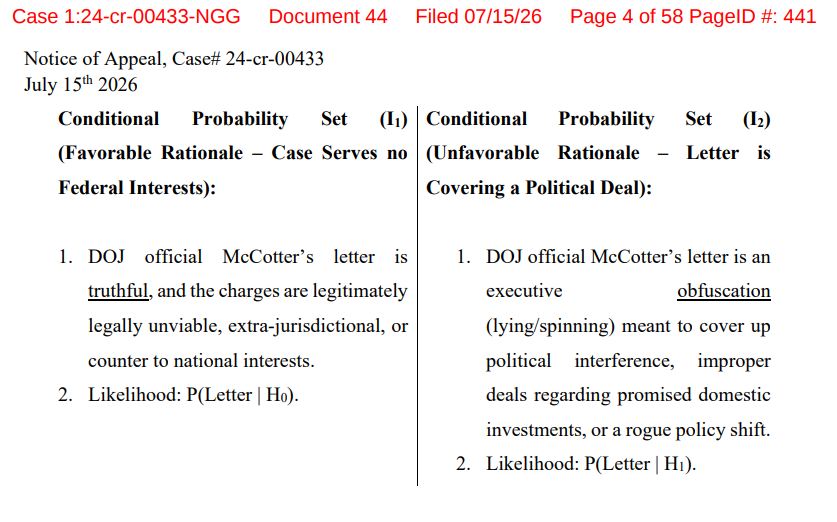
In the meantime, a purported whistleblower who previously made filings in the matter, has filed a very long motion stating that the DOJ’s position on the dismissal “fails under Bayes Theorem … a probability-based theorem or formula that allows [one] to update the likelihood of an event based on prior knowledge and new evidence. It is widely used in statistics, machine learning, medicine, and decision-making under uncertainty.”
I’m not going to go down that rabbit hole, but below is brief visual excerpt from the filing.