


In February 2026, Charles Hunter Hobson (who served in a variety of roles at Corsa Coal from 2013 to 2018) was found guilty by a jury for various Foreign Corrupt Practices Act and related offenses in connection with an Egyptian bribery scheme.
As stated by the DOJ, the bribery scheme involved “Al Nasr Company for Coke and Chemicals (Al Nasr), which was then a state-owned and state-controlled chemical manufacturing company in Egypt.”
The issue of whether Al Nasr was an “instrumentality” of the Egyptian government, such that employees of Al Nasr could be “foreign officials” under the FCPA, was the focus of a specific jury instruction and this prior post discussed how it was flawed.
This recent post discussed Hobson’s motion to dismiss based on the court’s supervisory powers.
Although the motion largely focuses on – in the words of the motion – “the government improperly us[ing] a five-year-old proffer to deprive a United States citizen of his constitutional right to a fair trial,” “foreign official” issues are touched upon in the motion.
The motion states:
“Al Nasr’s status as an instrumentality of the Egyptian government was an element the government had to prove. It is what makes this an FCPA case. It proved that element with a paid expert, and then used the expert’s answer to carry the element actually in dispute: what Hobson knew.
Professor Arafa told the jury that a 1961 presidential decree created Al Nasr, that the State owned and funded it, and that the government named its board. Day 3 Tr. 56–57, 59–78. Then he gave the ultimate opinion: Al Nasr “is owned by the Egyptian government 100 percent.” Id. at 78. Every word of it came from English translations of Egyptian decrees he could not source. “You don’t know where the translation came from? A. I don’t.” Id. at 83–84. He had told the jury he reviewed “the English translations of these documents as well,” id. at 56, so the man vouching for the translations could not say who made them. The decrees reached the jury in a slide deck built by DOJ lawyers and the witness. The government never offered it, so nothing was admitted, and the Court allowed it published anyway because an expert “can rely on virtually anything.” Day 3 Tr. 48. So the jury settled a foreign government’s ownership of a foreign company on the word of a man reading a document no one vouched for, translated by people no one named.
The government used the same technique on the decrees. Asked whether the Court had already ruled on them, it answered: “We’re not seeking to admit these as exhibits. Professor Arafa will be testifying regarding Egyptian law. So I don’t think—there’s no necessity of a ruling of authenticity or hearsay in that matter.” Day 3 Tr. 47. No exhibits, so no authenticity ruling and no hearsay ruling. The decrees reached the jury anyway, in the expert’s mouth.
The government had promised otherwise. At the pretrial conference, when counsel objected that instrumentality belonged to the jury and not to a law professor—“[t]hey’re supposed to determine that company is a foreign instrumentality, not the law professor”—the government assured the Court that Professor Arafa “will certainly not be testifying to whether it is an instrumentality under U.S. law,” that he “will not be assessing the Esquenazi factors,” and that “[h]e will be testifying to the Egyptian law.” Feb. 4, 2026 Tr. 44. On that representation he was permitted to testify. He then gave the jury the ownership opinion set out above, and in summation the government told the jury he had been “qualified by this Court” to give it. Day 6 Tr. 119. The witness the Court admitted is not the witness the jury heard.
[…]
The government avoided confrontation by calling no Egyptian witnesses or translators and instead paying Professor Arafa to read records he’d be given and that were never admitted, tell the jury what they meant, and deliver the ultimate opinion on an element. By using Arafa as a filter, the government side-stepped meaningful Confrontation required by the Constitution. Counsel questioned Professor Arafa and objected. What no one could do was confront the translator, because the government never produced one. Not one Egyptian witness showed up for the trial. Just a paid “expert” who would tell the jury the government’s evidence on key issues was sufficient.
Consider the element that makes this a federal case at all. If Hobson had been charged with robbing a bank, the government would have to prove the bank was FDIC-insured—the fact that federalizes the offense. No court would let it prove that through a cooperating teller who helped empty the vault, had no responsibility for the bank’s insurance, knew nothing beyond a sticker on the door, and with zero participation by the bank in the prosecution. The certificate comes in, and a custodian who can be cross-examined. The instrumentality element got lighter treatment here for one reason: this was an FCPA case and the government did not have foreign witnesses who cared enough about the government’s foreign bribery prosecutions to show up and participate.
But due process does not thin out because the government wants to spend taxpayer dollars focusing on foreign bribery with purported victim countries who have zero interest in the government’s prosecution. As a witness told Congress when the FCPA was written, it would be “repugnant to try a person in this country for the violation of a law . . . the witnesses to which are not available in this country.”
[A footnote states: When the conduct occurs abroad, Representative Eckhardt (a key participant in the drafting of the FCPA) observed, a defendant tried in the United States confronts witnesses who are “halfway across the world,” while “the government would undoubtedly have both the resources and the ability to bring in witnesses from overseas whereas the individual would have a very difficult time bringing in witnesses to rebut such testimony.” He warned against placing on an individual a burden so heavy “that we effectively deny him what is considered ordinary due process of law in this country,” and called it “repugnant to try a person in this country for the violation of a law of this country . . . the witnesses to which are not available in this country.” Unlawful Corporate Payments Act of 1977: Hearings on H.R. 3815 and H.R. 1602 Before the Subcomm. on Consumer Prot. & Fin. of the H. Comm. on Interstate & Foreign Commerce, 95th Cong. (1977).”]
Hunter reminds the Court it should not become a willing participant in the government’s effort to cheat the Constitution.
[…]
He was put in front of the jury to decide an element, on documents no translator authenticated. And this Court had already ruled he could not testify to the ultimate issue under American law. Day 6 Tr. 136. Instrumentality is demanding and fact-intensive. It turns on the foreign government’s ownership, its control, and whether the entity performs a function the government treats as its own. ECF No. 181, at 65–66. A specialized, dispositive fact may not be proved by funneling it through a conduit and calling the result an opinion.
[A footnote states: Hobson does not concede that United States v. Esquenazi, 752 F.3d 912 (11th Cir. 2014), states the correct rule. The statute reaches an officer or employee of a foreign government “or any department, agency, or instrumentality thereof.” 15 U.S.C. §§ 78dd-1(f)(1)(A), 78dd-2(h)(2)(A). Congress did not write that phrase to reach the employees of commercial enterprises a foreign state happens to own, and the Third Circuit has not adopted Esquenazi. Hobson preserves the argument that Al Nasr’s employees are not foreign officials as a matter of law. The argument in text assumes Esquenazi arguendo and shows that the government failed to prove even that standard.”]
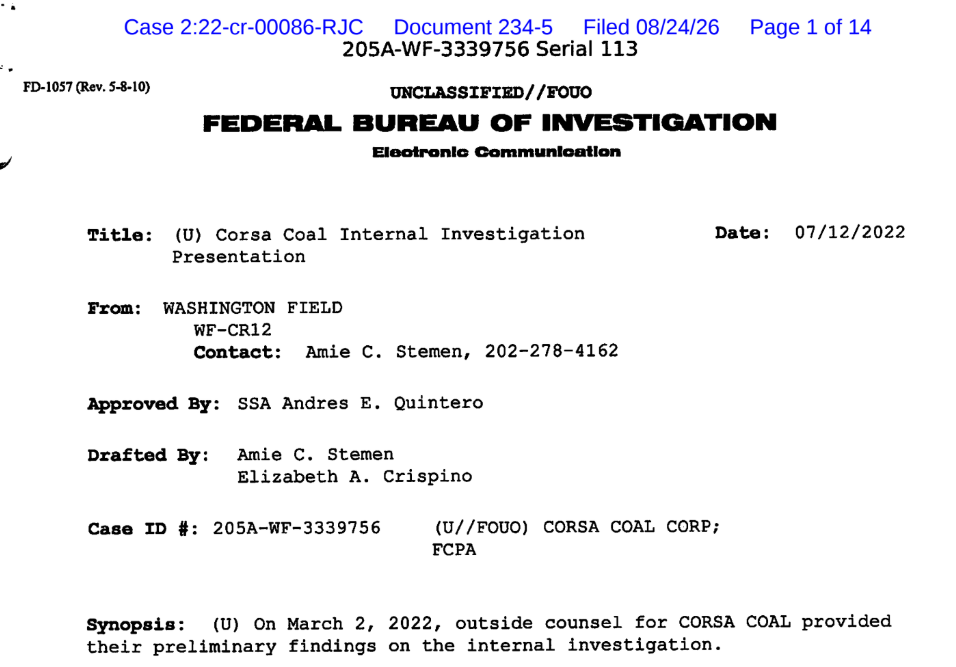
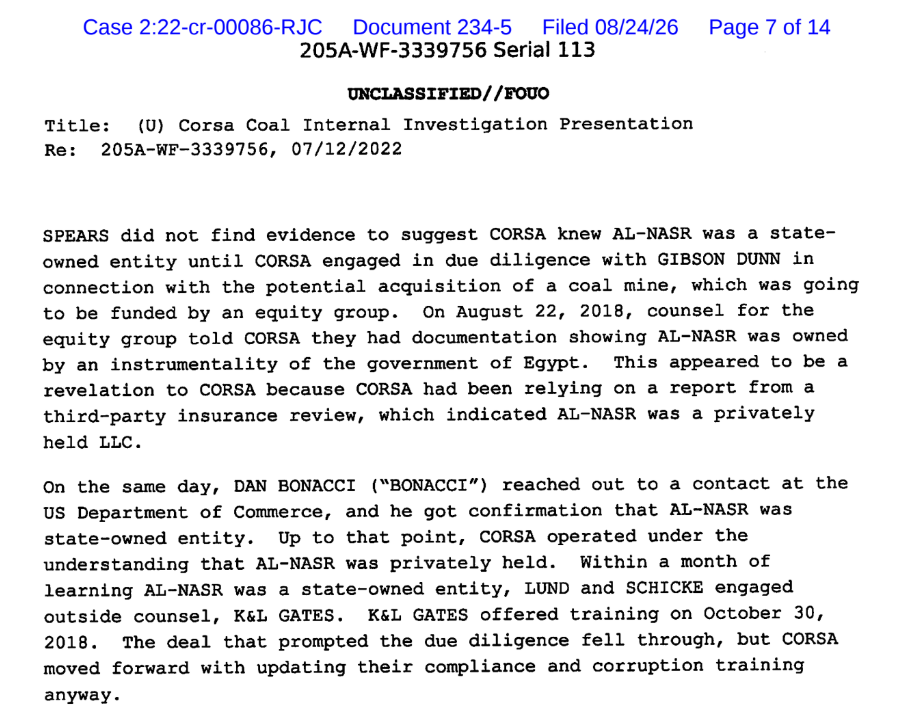
The motion to dismiss also includes an exhibit of the FBI’s “302” from a March 2022 presentation Corsa Coal’s counsel Spears & Manning provided to the government regarding its preliminary internal investigation.
Set forth below are relevant portions.
According to the DOJ indictment, Hobson left Corsa Coal in March 2018.
