This prior post highlighted a recent DOJ FCPA enforcement action concerning an alleged bribery scheme in Mexico.
The indictment charges Ramon Alexandro Rovirosa Martinez (a citizen of Mexico and a lawful permanent resident of Texas) and Mario Alberto Avila Lizarraga (a citizen of Mexico and lawful permanent resident of Texas) for their roles in an alleged bribery scheme to retain and obtain business related to Petróleos Mexicanos (PEMEX), the state-owned oil company of Mexico, and PEMEX Exploración y Producción (PEP), PEMEX’s wholly owned exploration and production subsidiary.
Last week, Rovirosa’s attorneys (Ryan McConnell, Matthew Boyden, and Lawrence Finder – all former DOJ prosecutors) filed a motion to strike the DOJ’s reference (not in the indictment, but in a separate motion) to Rovirosa being associated with Mexican cartels. (See here for the prior post).
Earlier this week, Rovirosa filed a motion to dismiss stating in summary fashion.
“This motion focuses on the tipping point where a criminal case must be dismissed based on the government’s outrageous, intentional, and unconstitutional actions in violation of the Fifth and Sixth Amendment. The government turned their weak oil and gas Foreign Corrupt Practices Act (“FCPA”) case into a violent Mexican drug cartel case with a false narrative to make politicians happy and gain an unfair advantage. Prosecutors created this story by filing a false document in the Court’s record and then using that document to label Mr. Rovirosa a violent Mexican drug cartel associate across global news organizations, in violation of his constitutional rights. Mr. Rovirosa cooperated during the government’s investigation. He is an innocent man. The government’s novel effort to weaponize political messaging and fear against a defendant to tip the scales in their favor at trial is without modern precedent. This motion tells that story and explains why the prosecutors’ conduct must result in dismissal of their Indictment. This case pits politics, racism, and unethical prosecutors against the Constitution.”
(See here for the prior post).
Yesterday, Rovirosa filed another motion to dismiss based on statute of limitations. In summary fashion, the motion states:
“The Indictment charges Mr. Rovirosa and defendant, Mario Avila (“Mr. Avila”), with conspiring to violate the Foreign Corrupt Practices Act (“FCPA”) and three substantive FCPA counts. The Indictment, according to prosecutors’ “discovery” letter, confirmed this was an oil and gas-related case based on some text messages allegedly sent in the Houston area. As outlined in Defendant’s Motion for a Bill of Particulars, virtually all of the alleged conduct and text messages in the Indictment relate to activity that occurred in 2019 and 2020, beyond the statute of limitations.
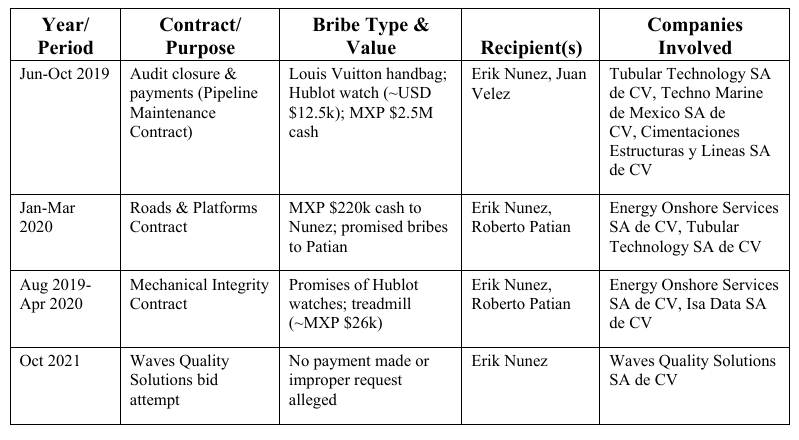
The Indictment charges a conspiracy that began in 2019 and ended in 2020, with the last act described as part of this conspiracy in April 2020. The Indictment throws in a fourth scheme and says it was part of the 2019 and 2020 conspiracy. The chart below sets forth the four schemes alleged in the Indictment:
The conspiracy in the Indictment ended in April 2020. The case was indicted on August 5, 2025. The statute of limitations ran on this conspiracy in April 2025. The government improperly added text messages related to a seventh company and never mentioned anywhere in the indictment, in the fourth “scheme,” Waves Quality Solutions, which occurred in 2021, to try to slip the conduct past the statute of limitations for the conspiracy count.
A quick glance at the chart above reveals one of these things is not like the others. Indeed, the only similarity between the conduct in 2021 scheme and the others is Foreign Official 1, Erik Nunez (“Mr. Nunez”). More problematic, the text messages between Mr. Nunez and Mr. Avila (no mention of Mr. Rovirosa), do not show Mr. Avila suggesting anything even remotely improper—they are idle chatter. The government knows that Mr. Avila is a former public official and Pemex employee who had a prior relationship with Mr. Nunez. Mr. Rovirosa did not. What the text messages look like, at best, are communications between longtime friends. Nothing improper is alleged at all. The government’s effort to fit their text message conspiracy claim within the statute of limitation is prohibited by law. Even worse, and the government likely knows this, Counts 2, 3, and 4, are flatly time barred—there is not even a good faith argument that fits those counts within the statute of limitations.
The defendant has outlined in its Motion to Dismiss, on the basis of the
Fifth and Sixth Amendment, how the government irrevocably poisoned this case by unethically and improperly filing false and improper documents in the record and spreading news releases worldwide urging the world to believe this is a “cartel” FCPA case for political purposes and to seek an unfair trial advantage. Defendant will not retell that story here, but it does provide context as to why prosecutors would go to extreme lengths to use unrelated, legal conduct to try to continue conduct proscribed by the statute of limitations—to bring their “cartel” FCPA case. This effort must fail.”