

Previous posts have focused on Foreign Corrupt Practices Act enforcement actions concerning conduct (in whole or in part) in Thailand, Vietnam, Indonesia, Malaysia and other Southeast Asian countries.
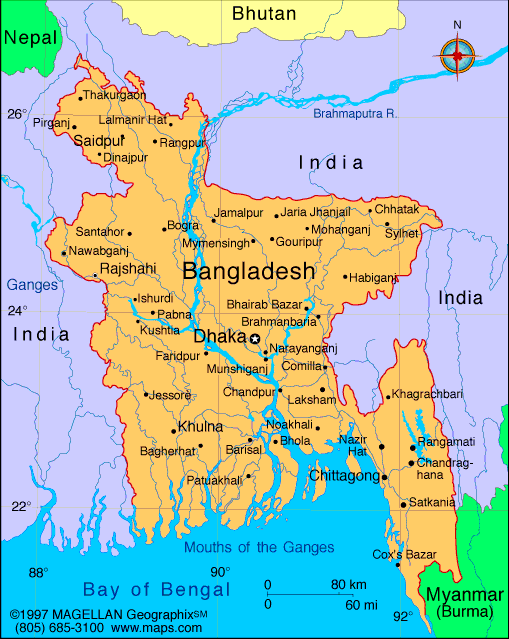
This post shifts the focus a bit west and highlights seven FCPA enforcement actions concerning conduct (in whole or in part) in Bangladesh.
The enforcement action concerned conduct in Angola, Bangladesh, Indonesia, Thailand, China, and Egypt.
As to Bangladesh, the allegations stated that an indirect subsidiary paid “$43,700 to an agent in Bangladesh with the understanding that the agent would use the money, in part, for corrupt purposes.”
The enforcement action concerned conduct in Pakistan, Indonesia, Turkey, Nepal and Bangladesh.
As to Bangladesh, the allegation stated: “Smith & Wesson authorized improper payments to third party agents who indicated that parts of these payments would be provided to foreign officials in … Bangladesh in unsuccessful attempts to secure sales contracts in those countries. Although these contemplated deals in … Bangladesh were never consummated in each case, the company had obtained or attempted to obtain the contract by using third party agents as a conduit for improper payments to government officials.”
The enforcement action concerned conduct in Bangladesh, Bulgaria, Egypt, Indonesia, Myanmar, Panama, the United Arab Emirates, and Vietnam.
As to Bangladesh, the allegations stated: “Aon Limited made approximately $1.07 million in payments to secure its account with Biman Bangladesh Airways and Sudharan Bima Corporation, two government-owned entities.”
The enforcement action concerned conduct in Costa Rica, Honduras, Malaysia, Taiwan, Kenya, Nigeria, Bangladesh, Ecuador, Nicaragua, Angola, Ivory Coast, Uganda and Mali.
As to Bangladesh, the allegations stated: “Alcatel generated a significant portion of its revenue in Bangladesh from Bangladesh Telegraph and Telephone Board, the state-controlled telecommunications services provider” and that Alcatel used an agent in Bangladesh but “Alcatel Standard did not conduct adequate due diligence” on the consultant. Additional allegations were that Alcatel Standard retained the agent in connection with a submarine cable project connecting fourteen countries and that Alcatel’s portion of the contract was approximately $258 million. Alcatel CIT paid the consultant approximately $626,492 in compensation for services provided in connection with the project and approximately $2,524,939 in connection with various upgrades to a predecessor of the project “aware of a significant risk that Bangladsh Consultant would pass on all or a part of these payments to foreign officials.”
The enforcement action concerned conduct in Venezuela, China, Israel, Bangladesh, Nigeria, Argentina, Vietnam, Russia, Mexico and Iraq.
As to Bangladesh, the allegations were: “Between 2004 and 2006, Siemens Communications paid approximately $5.3 million in bribes to government officials in Bangladesh in connection with a contract with the Bangladesh Telegraph & Telephone Board (“BT’TB) to install mobile telephone services. The. total value of the contract was approximately $40.9 million. The payments ‘were made to three business consultants pursuant to sham agreements calling for services associated with the mobile telephone project. The ultimate recipients of the payments included the son of the then-Prime Minister in Bangladesh, the Minister of the Ministry of Posts & Telecommunications in Bangladesh, and the BTTB Director of Procurement. In addition, Siemens Limited Bangladesh, a regional company, hired relatives. of two other BTTB and Ministry of Post and Telecom officials.”
The enforcement action concerned conduct in Iraq, United Arab Emirates, Bangladesh, Indonesia, Egypt, and India.
As to Bangladesh, the allegations were: “From 2001 to 2005, a representative engaged by [a wholly owned fifth tier subsdiary] made seven payments totaling approximately $ $16,342.14 to two “friends” employed by a government-owned fertilizer company in Bangladesh in connection with the sale of spare parts. Textron’s net profits from the sales involving the illicit payments were $93,396.”
The enforcement action concerned conduct in Benin, Nepal, Bangladesh, and Sri Lanka.
As to Bangladesh, the allegations were: “The Bangladesh government allows a maximum commission of one percent on sales to the military. On repeated occasions from 1999 to 2003, DWC [a division of a company acquired by Titan] created false documents that allowed its local agent to represent falsely to the Bangladesh Ministry of Defense that DWC’s local agent commissions were “nil.” In fact, DWC paid its Bangladesh agent net commission payments of $63,395, or approximately two and one half percent of sales. Although DWC’s Bangladesh agent resided in Bangladesh, all payments were made to offshore bank accounts in Singapore and London.”
