

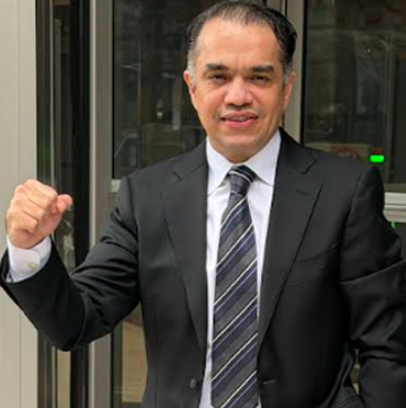
This morning, Ramon Alexandro Rovirosa Martinez woke up in federal prison where he has been held since early December 2025 after being found guilty of FCPA and related offenses in connection with alleged Mexican bribery scheme.
As reported here, the trial featured no fact witnesses which led the judge to block the government from introducing most of its evidence until their closing argument.
Earlier today (as shown in the picture), Roviorsa was released as U.S. District Court Judge Kenneth Hoyt (S.D. Texas) granted his motion to dismiss the criminal indictment and granted his motion for acquittal.
For prior posts on the case, including the bizarre trial, and post trial briefs see here, here, here, here, here, and here.
Judge Hoyt’s Memorandum and Order Dismissing the Indictment and Granting an Acquittal provides the following background:
“At pretrial proceedings, during trial and post-trial, Rovirosa asserted objections, primarily concerning his Sixth Amendment right to confront government witnesses whose testimony was necessary, he argued, to a fair trial and that was, instead offered through electronic messages. His objections focused primarily on the electronic messages between himself and Avila and between Avila and several alleged co-conspirators. These offerings, he contends violate Bruton v. United States, 391 U.S. 123, 88 S.Ct. 1620 (1968), as they involved conversations between Avila and alleged co-conspirators, and crucial Supreme Court precedent that addresses the interphase between the admission of “hearsay” statements allegedly made by Avila and co-conspirators, and the Sixth Amendment.
Rovirosa, therefore, contends that the electronic messages offered by the government are testimonial and, thus, are subject to the Confrontation Clause of the Sixth Amendment. In particular, he argues that the electronic messages that were translated from Spanish to English, were inadmissible because the Translators were not made available at trial for cross-examination. Further, he argues, their testimony was not offered to him prior to trial. As such, the admission of the Spanish or English translations violated the principles established in Crawford v. Washington, 541 U.S. 36 (2004) and Ohio v. Clark, 576 U.S. 237 (2015). As a result, during and at the conclusion of the government case and again after the jury verdict, Rovirosa presented a Rule 29(c)5 motion to dismiss the Indictment and acquitted him on all charges based on violations of his Sixth Amendment right to confront his accusers.
The government objected, then and now, to Rovirosa’s claim that a Sixth Amendment violation occurred, arguing that: (a) the electronic messages (Spanish to English translations) are to be evaluated no differently than other foreign language statements, writings, or recordings because they are hearsay in nature and communication between co-conspirators; (b) the proper procedure, the government asserts, for the admission of electronic messages is set out in United States v. Llinas, 603 F.2d 50 (5th Cir. 1979) and (c) “the translations were prepared by qualified Translators that supported their translations with certifications attesting to the truthfulness and accuracy of their translations. In addition, the government argues that the translations, were rereviewed by the case agent, Special Agent Maria Elena Varga, whom the government claims is equally, if not better, qualified then the Translators.”
Set forth below is Judge Hoyt’s analysis:
“After considering the relevant circumstances surrounding the government’s case, and its intended use of electronic messages between the alleged co-conspirators and the co-defendant, the Court determines that the messages are testimonial and are governed by common law and the Confrontation Clause of the Sixth Amendment. The Court finds that the messages of the coconspirators and, in particular, the co-defendant Avila, while they constitute hearsay messages, and would be admissible in a conspiracy setting, they are not automatically admissible here because, as translations, and when used to establish the case, they are testimonial. The government’s primary purpose for offering the messages was to convict Rovirosa, i.e. to prove the elements of the crimes charged in the Indictment. See Crawford, 541 U.S. at 51.
In reaching this conclusion, the Court finds that the government has not produced evidence showing that the Translators were unavailable or that Rovirosa was given an opportunity to cross-examine them prior to trial. The precedent is clear, the government had a duty to produce the Translators for cross examination.
The government turns next to the certification sequence for admissibility. It argues that Google or Yahoo and WhatsApp recorded the transmittals between Rovirosa, and between the alleged co-conspirators that were made on their own electronic devices capturing them in the regular course of their business activities. Hence, the government argues the messages are admissible under the business [records] exceptions rules. See Fed. R. Evid. 803(6). The government also argues that the Translators certified their translations under oath; and that Special Agent Varga reviewed the Translators’ translations and certified the accuracy of their translations. The Court will address these arguments, however, they are all unavailing.
Fed. R. Evid. 801(c) and (d) and 803(6), address hearsay exceptions that apply to business records or electronic messages when they are offered into evidence. Rovirosa does not argue that the translations were not properly certified by Google or others, or that the business records exception, generally, satisfies the hearsay rule exception such that out-of-court hearsay statements or documents may be admitted. Instead, he argues that, even if the federal rules of procedure or evidence are satisfied, the electronic messages must be excluded because: (a) the messages offered were translations from Spanish to English, between and among alleged co-conspirators and, as such, the Confrontations Clause prohibits admission if they are testimonial statements by a non-testifying witness. The precedent exceptions to this rule do not apply here because Rovirosa had no prior opportunity to cross-examine the witnesses.
The record shows that the government intentionally did not call as witnesses the Translators. Hence, Rovirosa was not provided an opportunity to cross-examine them prior to or during trial. Moreover, there is no evidence that the government could not have produced them. Nor is there evidence that the government made an effort to produce them. Hence, the Court concludes that Rovirosa’s right to cross-examine the Translators and the co-defendant, cannot be truncated by offering certifications, particularly since the Translators were available to the government. Moreover, Rovirosa’s right to cross-examine the Translators is not satisfied by the government’s tender of Special Agent Varga to testify that she re-examined the Translator’s translations and is of the opinion that they are accurate. To permit this type of “expert” evidence, turns on its head the science and art of proper translation considerations.
It is well accepted that Translators fall into one of two camps, those who use the pedagogic/literal format – word for word, or exercise poetic/dynamic, where the Translator seeks the pulse and tone of expressions in order to capture words and expressions. Cross-examination permits recognition of cultural sensitivity issues, specialized knowledge, and the level at which the Translator’s education and usage of the language may rest. To that add regional nuances and contextual consideration as the occasion dictates. To ignore the art and science of the translation process is to render cross-examination of the Translators, useless or questionable.
The jury recognized that the English translations short-circuited its review of the evidence, an evidentiary fact missed by the Court. During deliberations, the jury requested that the Court provide the Spanish messages during deliberations. The Court could not provide the Spanish messages because they had not been offered into evidence by the government. This failing by the government becomes more poignant when considered in the light of Rovirosa’s complaint that the government failed to produce forensic copies of the Spanish messages taken from both defendants’ electronic devices.
The government promised to produce the screen shots on at least two occasions. On September 26 and October 1, 2025, Department of Justice Attorney, Bennett Starnes, promised the materials. The materials were never produced, and this failing is also fatal to the government’s case.”
Judge Hoyt concluded:
“Based on the Court’s findings and conclusions, the Court GRANTS the defendant Rovirosa’s motion to dismiss the Indictment pursuant to Fed. R. Crim. Pro. 29(c); alternatively, to ACQUIT him of all charges based on lack of evidence to support his conviction in violation of the Confrontation Clause of the Sixth Amendment. He is ORDERED released, forthwith.”
Rovirosa was represented by Ryan McConnell and others with R. McConnell Group PLLC.
The firm issued the following statement:
The United States District Court for the Southern District of Texas, the Honorable Kenneth M. Hoyt presiding, today found Alex Rovirosa innocent of the charges brought against him in United States v. Rovirosa, freeing the Texas businessman to return to his wife and family.
The Court said the government intentionally did not call witnesses, and also found other unconstitutional discovery violations. Judge Hoyt stated at a hearing this morning that many of the defendant’s arguments may or may not be equally fatal, but the evidence, as presented, does not support a conviction. He ordered Mr. Rovirosa released immediately.
Importantly, federal prosecutors did not walk away or otherwise forfeit this case; the Court rejected the prosecution on the merits. Under the United States Constitution, this ruling is final and cannot be appealed. Mr. Rovirosa carries no conviction. He is an innocent man.
Research by the R. McConnell Group law firm indicates this is only the fourth time since the FCPA was enacted in 1977 that a United States district court has granted post-trial relief of this kind in an FCPA case.
“A United States district court judged Alex Rovirosa to be innocent after a full trial,” said Ryan McConnell, lead defense counsel of the R. McConnell Group PLLC team that also included Matthew Boyden and Lawrence Finder. “That is the strongest ruling our system can give. This case should never have been brought. These prosecutors needed a cartel case, but they didn’t have one. So they invented one and pinned it on a Hispanic businessman from Houston. When the evidence fell apart, they doubled down. When the Court ruled Alex innocent, the prosecutors asked that he be kept in a cell anyway. That is not a prosecution. That is an abuse of power.”
The prosecutors’ case against Mr. Rovirosa had no cooperating witnesses. Instead, their case rested almost entirely on English translations of Spanish text messages — translations that were riddled with errors that no one was willing to stand behind in court. The prosecutors also withheld evidence and trampled Mr. Rovirosa’s constitutional rights before, during, and after the trial.
Although prosecutors filed a court paper on day one claiming Mr. Rovirosa had “ties to Mexican cartel members” and then amplified their smear in a subsequent press release, those same prosecutors never brought any cartel charges. No cartel evidence was ever introduced at trial. Witnesses in Mexico, afraid of this fabricated cartel connection the government invented, refused to come testify in Mr. Rovirosa’s defense.
The cartel smear was not the only line prosecutors crossed. They hid evidence — forensic copies of phones and devices the defense had a right to see — and told the Court, twice, that everything had been turned over. It hadn’t. Furthermore, their case rested on a convicted money launderer with no connection to the company at the center of the charges, and an “expert” falsely described to the jury as a Mexican-trained lawyer. They also played a secretly recorded interview to the jury containing statements Mr. Rovirosa’s lawyers could not cross- examine — a violation of his Sixth Amendment right to confront the witnesses against him. They twisted an unrelated comment into what they told the jury was a confession. They held back their core text-message evidence until closing argument, when the defense could no longer question anyone about it. The right to see the evidence against you, the right to confront your accusers, the right to a fair trial — each one was violated.
“The conduct in this case fell well short of what federal prosecutors are expected to uphold. A man was publicly smeared, tried on a theory the evidence did not support, and — even after the Court found Mr. Rovirosa innocent — the government asked that he remain in custody. The record speaks for itself,” McConnell added.
Rovirosa, who was scheduled to be sentenced later this month, is instead returning home as an innocent man after enduring abusive treatment and vile smears at the hands of federal prosecutors.
“I came to the United States believing in the American dream. I built a business, raised a family, worked hard, and played by the rules,” said Rovirosa. “When these charges came, I never lost faith. Not in this country. Not in its courts. Not in its Constitution. I believed that, if I held onto the truth, an American court would see it. Today, the United States District Court did. I am grateful to the Court. I am grateful to my wife, Tanya, to our children, and to my legal team for never letting go. My faith and God helped me persevere through this ordeal. And I am grateful to the American legal system. It can be pushed, and it can be tested. But when it works, there is no other system like it in the world. Today, it worked. I am going home.”
